10 Years of GW Astronomy: Satisfaction Coupled with Concerns

Ten years ago today, 14 September 2015, in the early hours of an ordinary American morning, an exceptionally strong gravitational wave chirp flew through LIGO‘s Hanford and Louisiana detectors, after having traveled across the Universe at the speed of light for something like a billion years.

Nobody (myself included!) was expecting it, even though almost certainly similar chirps had passed through the two detectors before, given that the detectors had been taking science data on and off since 2002. But this time was different, because LIGO was just restarting after a five-year-long major sensitivity upgrade. It hadn’t been sensitive enough to catch the earlier ones, but it heard this one loud and clear. The arrival of GW150914 therefore marked the dawn of gravitational wave astronomy as a new and promising research field.

This first detection has been followed by well more than 200 further detections. Events are now being registered several times a week. Among the early detections was the profoundly important LIGO-Virgo observation of GW170817, in August 2017: two neutron stars spiraled together, merged, exploded, and taught us where our gold, silver, platinum, and uranium came from. This event led to a continuing collaboration of GW astronomers with other kinds of astronomers, something we call multimessenger astronomy. A few months later, the Nobel Committee confirmed the importance of this new field by awarding the 2017 Physics prize to Barry Barish, Kip Thorne, and Rai Weiss1.

During these ten years, a completely new way of detecting GWs has also made its debut: the pulsar-timing radio-telescope arrays have almost certainly detected a random cosmological background of ultra-low frequency GWs generated by the orbits of countless supermassive black hole binaries. This remarkable first decade of GW astronomy has brought us solid evidence, intertwined and in abundance, of the reality of all of Einstein’s theory’s most radical and unexpected predictions: waves of gravity, black holes, and Big Bang cosmology.

Naturally, the GW community is celebrating this anniversary. For my part, I am joining my good friend Clifford Will and many of our colleagues at a two-day meeting in Palma, Mallorca, which starts tomorrow. We will be looking backwards at what our community has achieved, and forwards at what we should be doing in order to keep this extraordinary momentum going. In this post, I want to muse about the future, because it has such promise and yet has to face possible pitfalls.

The LIGO and Virgo detectors are already significantly more sensitive than ten years ago. Further big upgrades are already being built and tested in labs around the world, in preparation for installation starting next year; the young Japanese KAGRA detector has an ambitious roadmap for improvement; India is building a third LIGO detector; and the space-based LISA gravitational wave mission is in Phase B of construction by the European Space Agency, having been handed over to the prime industrial contractor, on schedule for a 2035 launch. Into the 2040s we can hope for completely new third-generation ground-based detectors in Europe (Einstein Telescope) and the US (Cosmic Explorer), whose designs are already well advanced.

These upcoming instruments carry scientists’ high hopes for new science, unexpected or unpredicted discoveries. One remarkable and somewhat puzzling aspect of observations so far is that all the GWs detected so far originated from binary systems formed of black holes and neutron stars, whose brief death spiral emits a “chirp” of GWs and then falls silent, forever. Many other sources are expected, ranging from nearby asymmetrical spinning neutron stars emitting GWs continuously to distant exotic cosmic strings whose intense gravity emits a sharp burst of GWs when two of them happen to encounter one another. We apparently need even better sensitivity to detect the former; and we might just have to get lucky for the latter.

Future observations also should ultimately return the best-ever measurements of the expansion rate and acceleration of the Universe, values which are still a lot more uncertain than they should be. Their uncertainly lies in disagreements between values obtained by different methods, and I hope that the gravitational wave “standard siren” method will help resolve this, because it uses such different kinds of information than other methods rely on.

But all of this hope for the future is now hedged by uncertainties. One of the biggest is, of course, American political decisions about supporting science. We have seen devastating cuts in health research, including the halting of life-saving work mid-stream. The threats to space and ground-based science are also scary, although final decisions have not yet been made. There is talk of withdrawing NASA’s 20% contribution to LISA, as well as reducing LIGO to one detector, which would destroy its science return; LIGO itself has said it hopes that, if such a cut were made, then it could operate both detectors on a much reduced budget, presumably stopping the development of future upgrades and relying on university partners for keeping things going. We are hoping that Republican members of Congress will understand the importance of continuity in basic research and will vote that way, but the outlook is very uncertain. And that puzzles and distresses me, because besides being a Nobel-winning flagship for fundamental science — an endeavor that has captured large chunks of the public imagination –, LIGO and its partners have been wonderful training grounds for many hundreds of young scientists who eventually have taken their skills into industry. In the worldwide collaboration, they learned rigorous science, they learned how to push the frontiers of measurement time and again, and they learned how to work successfully and rewardingly in a huge international team. What could be better raw material for 21st century industry?

The other concern I have is that much of the future science return from our network, even if LIGO remains well funded, depends on having three detectors of comparable sensitivity, so that the sky positions of sources can be triangulated. With only two detectors, as we had for GW150914, we have big errors in the estimates of the masses and distances of sources, because our detectors have different sensitivity in different directions. We currently observe mainly with three detectors, the two LIGOs and Virgo. But Virgo has not been able to match LIGO’s sensitivity, typically observing with only 1/3 of LIGO’s sensitivity. This affects the number of events we can reliably detect, but even more it gives us poor direction-finding, which makes all the other measurements (masses, distances, spins) more uncertain. With time and with new contributions from KAGRA and LIGO-India, we can hopefully relieve this problem, but in the near term it stretches out the time it will take the network to reach any particular measurement goal, and makes the science output even more vulnerable to political issues over funding in the future.

Virgo’s problems do not come from a lack of talented scientists, although they may be a bit understaffed. Rather, it shows how incredibly difficult it is to build these instruments, so much so that small differences can have large negative effects. These are the most precise measurements ever made by humans, and getting within one-third of the best attempts is no mean feat. One of Virgo’s disadvantages was that it started ten or more years later than the teams that eventually merged into LIGO, and because of this they decided to go straight from the drawing board to the 3-km detector without operating an intermediate prototype stage for training and learning. But in my view, which I have expressed publicly on other occasions, there was another fateful decision at the time Virgo was organizing itself: it formed up as a collaboration of a number of research institutes, with no strong central management structure. It is led by a ‘spokesperson’, as is typical of particle-physics experiments, rather than by a ‘director’, which LIGO has, as do other successful European international science projects, such as ESA, ESO and the SKA. In fact, despite the heritage of the Virgo organizational model in particle physics, CERN itself also has a director, steering a strong management structure that has ensured that accelerator after accelerator has reached its design goal, making CERN the most important accelerator lab in the world. The Virgo organization model inevitably takes longer to make hard decisions, and design decisions can be weighted by inter-institute political and budgetary considerations rather than just by what is technically and financially optimal.

If this were a problem only affecting Virgo, then we could hope that with time it would get resolved, or at least would become less important as KAGRA and LIGO-India near their design goals. But the problem might run on longer than that: the next-generation European Einstein Telescope may soon receive its initial funding, but the organizational structure of its current collaboration looks to me to be just as decentralized as that of Virgo. As we look past 2040, there may again only be the two detector projects mentioned above for the third generation, and if Europe does not learn from the difficulties that Virgo has had to deal with, then it might endanger a truly golden chance to probe the Universe more deeply and more fundamentally than can even be conceived of today.

So as we celebrate what we accomplished ten years ago, I hope we will also learn lessons from the succeeding ten years about how we can optimize our research future … if the politicians don’t succeed in taking away that future!

  1. I dedicate this post to Rai, who passed away less than three weeks ago. LIGO was his conception, and he worked tirelessly for over 40 years to realize it. His modesty, mentorship, and good humor have strongly influenced the character of the worldwide GW collaboration. It is still difficult to process that he is no longer with us. ↩︎
The merger of two neutron stars, one year on: GW170817

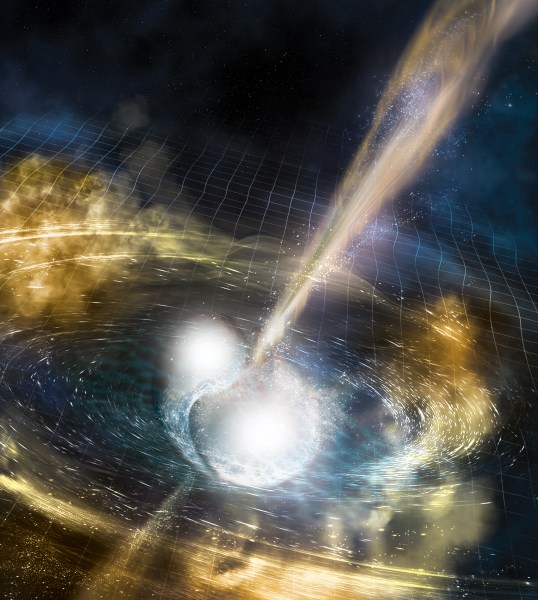
Last Friday we celebrated the one-year anniversary of an event that those of us who were involved will never forget. The Virgo gravitational-wave detector had joined the two LIGO instruments on August 1, 2017, and the three detectors had since then been patiently listening out together for gravitational wave sounds coming from anywhere in the Universe. On August 17, the deep quiet was interrupted by a squeal, a chirp lasting much longer and going to a much higher pitch than the GW150914 chirp that had launched the field of gravitational wave observational astronomy two years earlier. We named it, prosaically, GW170817.

GW170817-rendition
[Credit: NSF/LIGO/Sonoma State University/A. Simonnet]
This one-minute-long squeal was followed by an incredible explosion that radiated intense gamma-rays, X-rays, light, radio waves — right across the whole electromagnetic spectrum. What came first was a burst of gamma-rays, just 2 seconds after the end of the squeal. Then it began brightening up at other wavelengths. The explosion itself did not register in LIGO and Virgo, because as it rushed out in all directions it was too smooth to generate gravitational waves. But astronomers at their telescopes saw it: a kilonova, a new type of cosmic explosion. 

You may like to think of the chirp as the sound of a fuse, the fuse that triggered a giant explosion. The chirping sound was produced by two neutron stars orbiting one another at nearly the speed of light. The pitch of this gravitational-wave sound is at twice the frequency their orbit. Their orbital motion stirs up gravity near them, and this creates gravitational waves. These waves take away energy, and this friction brings the stars closer together. The binary that became GW170817 had probably formed billions of years earlier, with widely separated stars. At first the weak gravitational waves carried away energy so slowly that the system hardly changed from one millennium to the next. But eventually, inevitably, the stars drew so close to one another that the waves had frequencies of around 20-30 Hz, and they entered the observation frequency band of LIGO and Virgo. The emitted waves were very strong by then, and so the system was evolving quickly, shrinking noticeably with every orbit, the gravitational wave pitch rising rapidly. Within another minute or so, the stars made contact, triggering the kilonova. I mentioned in my post of June 9 last year that we were hoping to detect this kind of event with neutron stars, and ten weeks later it happened.

You can listen to the reconstructed sound of this death-spiral, this fizzling fuse, in the video here, although you need patience, because for most of the one minute its pitch is too low for normal hearing. LIGO and Virgo can go to deeper pitches than the human ear. But the end is worth waiting for, because of what it says about the stars: as the pitch approaches about 1 kHz (two octaves above middle C), the stars are orbiting one another 500 times each second!

What blew up after the chirp ended? 

Previous gravitational wave detections had also recorded chirps, but these fuses had finished without igniting explosions. That is because they were the gravitational wave sounds made by orbiting black holes, which are strongly curved but empty space. So when they came together, they formed a bigger black hole, but it was still just empty space. There was nothing to explode. But last year, the things that came together were neutron stars, and they smacked together at something like 20% of the speed of light. Perfect for creating an enormous splash.

Neutron stars are not ordinary stars like our Sun. They are stars formed from the remains of a normal star that has run out of its nuclear fuel, so it can no longer maintain its original size against the pull of gravity. Astronomers know about two kinds of such “remnant” stars: white dwarfs and neutron stars. Our Sun will form a white dwarf in the end (some 5 billion years from now). It will shrink down to the size of the Earth after slowly boiling away maybe half of its gas (and incinerating the Earth in the process). Much bigger stars than the Sun end much more dramatically in what we call supernova explosions, and these usually leave behind a neutron star, which is typically a little heavier than our Sun but is only the size of a big city, about 20 km across. Neutron stars are sometimes described as “dead” stars, or as “cinders” left by the supernova, but in reality they are balls of tightly packed explosive, just waiting for something else to set them off.

What kind of explosive material is a neutron star made of? 

Some of the densest things we normally deal with in everyday life are made up of atoms that fit very tightly together, packed right up against one another: we call them crystals, like diamond. But a diamond the size of a city (what an image!) will not have anything like the mass of the Sun; it will only have roughly the mass of a city. So if you want to pack all 1057 of the Sun’s atoms into a ball the size of a city, there will be no room for the atoms to be ordinary atoms. Instead, they get squashed together until their nuclei bump together and merge — the neutron star becomes basically one big atomic nucleus, an element with atomic weight 1057.

Now, a nucleus is unstable if its atomic weight is more than 240 or so, i.e. above uranium. So a nucleus with atomic weight 1057 is not something that would normally stay together for more than a fraction of a second, let alone millions of years. It is intrinsically very unstable, very unhappy being so big and dense. It only stays together as a star because of the tremendous force of gravity holding it in.  

To get a feeling for how strong gravity is on a neutron star, imagine trying to stand on one. Your body would weigh several trillion kilograms — except that it wouldn’t, because that much weight would squash you, and gravity would just merge the few atoms that are you into the vast pool of nuclei already there. In fact, the whole neutron star is pretty close to being pulled in too much by gravity — it is just on the edge of collapsing into a black hole. It manages to resist this pull because the nuclear matter hates being compressed so tightly. The matter pushes back, and this just barely manages to keep the star in balance.

So how do neutron stars explode? 

Given this tricky balance, neutron stars are okay if they are left alone, or if a bit of stuff just gradually falls onto them. But smashing two of them together at close to the speed of light is a different story. That will knock a lot of the stuff off of the surface; and once that material is freed from its confinement, it goes wild. All the energy that was put into compressing it in the first place is now available to help it escape the neutron star’s gravity. 

The result is a huge kilonova explosion, a cloud of matter expanding away from the site of the collision initially at close to the speed of light, incredibly hot material, full of twisted magnetic fields, giving off radiation across the spectrum. It is a display to entertain astronomers of every persuasion. When GW170817 happened, it is said that something like 10% of all the world’s professional astronomers rushed to their telescopes.

But in fact only part of the neutron star stuff exploded away. When the stars collided, their combined gravity actually got stronger, because there was now nearly twice as much mass. This immense gravity squashed the two stars into one, holding onto most of the original matter. And although a single neutron star can generate enough pressure inside itself to resist collapse, a neutron star with twice the normal mass probably can’t. So the final merged remnant in GW170817 most likely collapsed to a single black hole.

The gamma-ray burst that happened just 2 seconds after the stars merged would have been triggered by this collapse. A beam of this radiation pierced through the already expanding cloud of escaping matter and announced the explosion to us. The material that blew off was the lucky stuff: the rest of our two neutron stars has fallen into the black hole that the stars themselves created, disappearing forever.

Why did everyone get so excited by a couple of neutron stars colliding, so far away? 

Normally astronomers don’t know about it when an explosion like this happens. They may chance across evidence of it long afterwards, but by then it is too late. So when the gamma-ray and gravitational-wave astronomers quickly spread the word that this explosion was just starting, astronomers rushed to monitor it. In fact some of them are still watching it, using telescopes in the radio and X-ray parts of the spectrum. 

One of the reasons for wanting to watch it happen is that kilonovas like this are rare, occurring maybe once every 100,000 years in any one galaxy. The gravitational waves from GW170817 told us that the explosion had happened in a galaxy 120 million light-years away. This may seem like an enormous distance, but for LIGO and Virgo this was exceptionally close: they could have seen it even if it had been three times more distant. And for astronomers this is also pretty close: even modest-sized professional telescopes could study it.

But the interest in GW170817 is not just its rarity. What is even more interesting is that neutron-star mergers have played a surprisingly important role in enabling life on Earth, and even for human evolution. This is because of what the stuff that is blown off in the kilonova turns into. It starts out, remember, as part of one big nucleus. As it expands away, its nuclear instability reasserts itself, and it breaks up into chunks. This is nuclear fission on a grand scale, and the kilonova event is nothing less than a gigantic atomic bomb, something like a 1035 megaton explosion. 

The initial chunks are still huge, so they keep breaking up into smaller and smaller chunks, until the chunks are small enough to be stable atomic nuclei again. At this point the nuclear fission stops. The expanding cloud ends up made up of stable atoms, but its composition is strongly biased toward the heavier elements of the Periodic Table.

Now here is the important bit: astronomers have come to the conclusion that this is the main way that these heavy elements are made throughout the Universe. Most of the ordinary matter in the Universe (and in our Sun) is just hydrogen and helium, the two lightest elements. So essentially everything else has to have been made by stars. Astronomers’ observations of GW170817 have confirmed that the expanding cloud of gas was indeed heavily loaded with elements from the upper half of the Periodic Table. 

GW170817 and the origin of life

You may remember the newspaper stories about GW170817 when it was made public in October last year; they enjoyed talking about how all the gold and platinum in our jewelry must have been made long long ago in another similar explosion.

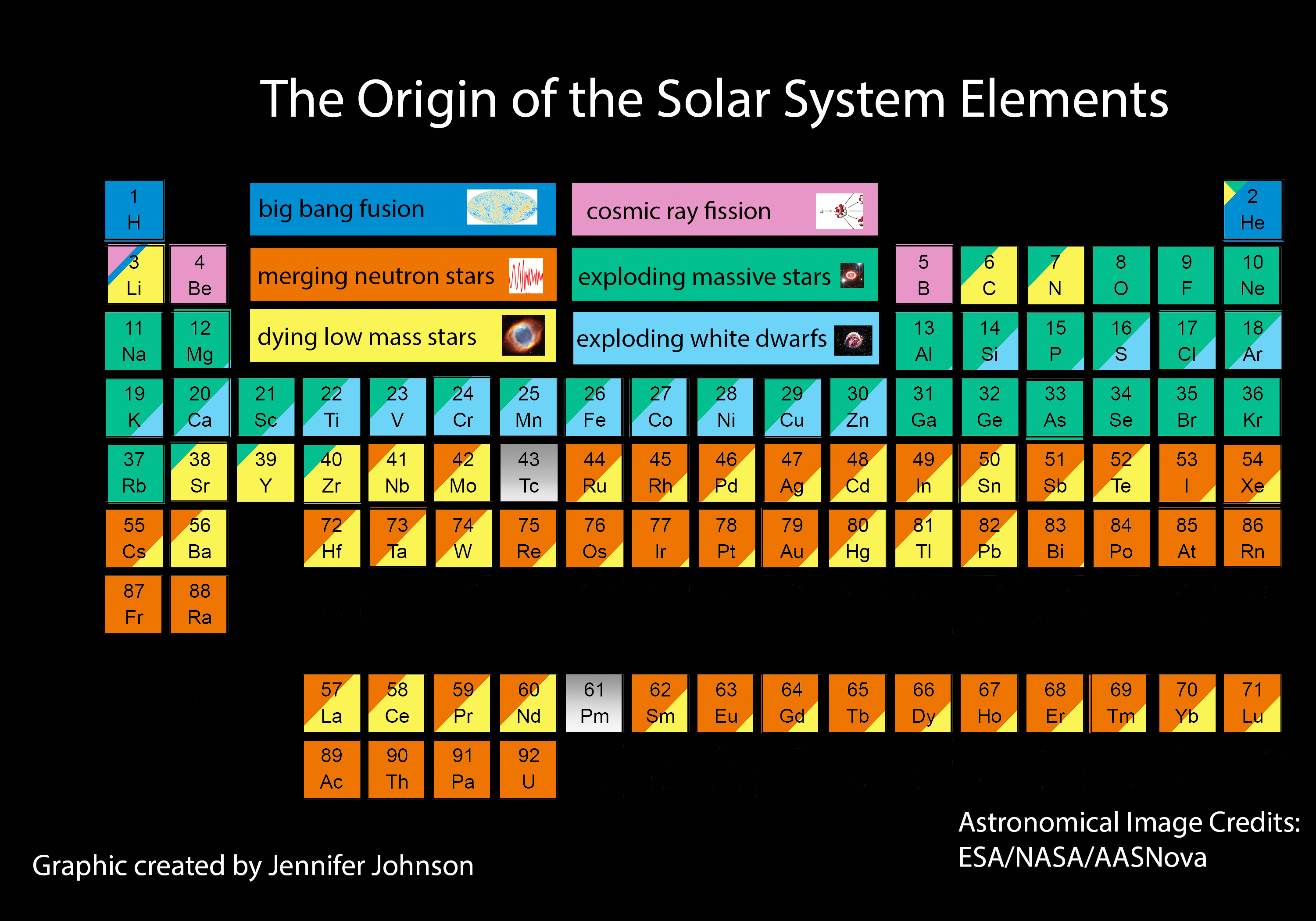
Now, although the extraordinary history of the gold in our rings is truly awe-inspiring, this actually misses the most important point. At least two of these heavy elements are essential to human life: molybdenum and iodine. As shown in the figure, iodine is produced almost exclusively from neutron-star binary mergers, and molybdenum (involved among other things in producing the body’s energy source ATP) comes from neutron stars and low-mass stars in roughly equal amounts.

periodic_table

And then there are thorium and uranium, which may have played a key role in the evolution of life itself. That is because the gradual decay of the long-lived uranium and thorium isotopes in the Earth’s mantel provides roughly half of the heat that, in flowing outwards through the solid Earth, drives volcanism and plate tectonics. In particular, the movements of the continents seem to need the extra heat generated by these ultra-heavy elements. These geological phenomena have played an important role in the evolution of life on Earth, by challenging species with a constantly changing environment that drives continued evolution. It does not seem unreasonable to speculate that, if the Earth had been geologically quiet, some well-adapted distant ancestor of ours might just never have needed to change, and evolution might have slowed dramatically or even stopped. 

The presence in our planet of all the elements in the heaviest half of the Periodic Table tells us that, sometime before the Sun formed 5 billion years ago, a neutron-star merger — driven by the loss of orbital energy to gravitational waves — happened in our own Milky Way galaxy, triggering its version the GW170817 kilonova. Its expanding cloud of heavy elements polluted a cloud of hydrogen and helium gas, and that cloud later collapsed to form the Sun. This gas cloud had also evidently been polluted with the lighter elements of the Periodic Table that had been formed in other much more frequent nearby events, such as in supernova explosions or in the gas blown away at the end of the life of stars like our Sun. The expanding cloud of a supernova or of the kilonova may even have triggered the collapse of the polluted gas cloud, which led to the formation of the Sun, and hence of the planets, and eventually of living things. 

We are, as has often been remarked, stardust. But there might just be one particular long-ago gravitational-wave-driven neutron star merger, probably very like GW170817, to which we owe our very lives. 

==============

I mentioned here but did not explain how the gravitational wave signal told us how far away the source was. This is a whole story in itself, and I will come back to it in a future post. It led to a milestone in gravitational-wave astronomy when we were able to use GW170817 to make a measurement of the expansion rate of the Universe, the Hubble constant.


!Happy Birthday GW150914!

Just a year ago today, after travelling some 1.4 billion years, the gravitational wave chirp we christened GW150914 passed through Earth. It disturbed the two gravitational wave detectors of the LIGO observatory enough for us to notice it, to get excited about it, and to get a large fraction of the general public excited about it! But GW150914 just kept on going and is now one further year along in its journey through the Universe. And it will keep going, spreading out and getting weaker but not otherwise being much disturbed, forever. Literally forever.

And GW150914 hardly noticed us! When we observe the Universe with our telescopes, detecting light or radio waves or gamma rays from the enormous variety of luminous objects out there, we capture the energy that enters our telescopes. The photons from a distant star terminate their journeys in our telescopes, leaving a tiny hole in the ever expanding cloud of photons that we didn’t catch. We simply eat up the ones we catch. But GW150914 transferred an absolutely minuscule amount of its energy into the LIGO detectors. We and the famous chirp enjoyed a brief handshake, and then it was gone.

Not that GW150914 had little energy to give: quite the opposite. At its peak, it was 20% as “bright” as the full moon! For the few milliseconds of its passage, GW150914 outdid any star in the sky. Of course, its energy wasn’t in the form of light, so it wasn’t visible to anyone who by chance happened to be looking straight at it. But the energy was there: the gravitational wave energy going through that lucky stargazer’s pupil was 20% of the light energy that would have gone in, had the stargazer turned to gaze at the full moon. The difference, as I noted above, is that the moon’s light energy would have been deposited in the stargazer’s retina; the gravitational wave energy didn’t stay around but just kept going through, leaving almost nothing behind.

It was the same story with all the other objects that GW150914 had encountered before it reached Earth. And it will be the same in the future, which is why the chirp will keep going, forever.

This seeming lack of engagement on the part of GW150914, its reluctance to share its energy with us, comes basically from the extreme weakness of gravity itself. Light and other forms of electromagnetic radiation connect to electric charges, and the coupling between them is strong because the electric force is strong, much stronger than gravity.

There is a simple way to get a feeling for the big disparity between these two forces. Pick up a tennis ball and you are demonstrating the immense superiority of the electric force over gravity. The weight of the ball is the result of all the atoms in our entire planet pulling back on it with their gravitational attraction. The electric force governs the structure of atoms and molecules, and regulates chemistry and the structure of materials. Your arm muscles’ chemistry easily defeats the total gravitational attraction, even though the muscle mass doing the work is less than one part in 10^24 of Earth’s mass. (That is, Earth has one million million million million times more mass than the muscles of one of your arms!) So when GW150914 passed through you (as it did one year ago), it was too weak to disturb you, so of course almost no energy was transferred to you.

How is this weakness consistent with the fact that it was carrying such a huge amount of energy? Here the best way to understand this apparent contradiction is to go back to Einstein’s basic picture of gravity, that gravity is the warping of space and time. It should be no surprise that it is exceedingly difficult to warp space. Before Einstein, nobody even thought it might be possible. A measure of how hard it is to bend space is that the waves of space that carry this warping, the gravitational waves, travel at the speed of light. Now, think about waves in other materials, and how stiffness of the material is related to the speed of the waves. Sound, for example, travels pretty fast through air but much faster through steel. Water waves travel rather slowly, but a crack in an ice sheet can streak across the sheet in no time flat.

By this measure, space is the stiffest medium we know, because its waves go at the speed of light, the fastest speed possible, a speed that is immensely faster than that of waves in any other material we know. But bending a stiff thing is hard, so bending space is hardest of all. To get GW150914 going required a huge energy input, even for a wave with such a weak effect on us. The chirp, as it started out, carried as much energy in total as one would get by converting the mass of three Suns into pure energy via Einstein’s famous E = m c². That was a blast equivalent to 10^34 Hiroshima-scale nuclear explosions. (That’s ten thousand million million million million million bombs!) All this energy came out in a fraction of a second. If you added up all the energy (in light, mainly) that all the stars and other objects in the entire Universe were putting out during that fraction of a second, you would come to a number that is 10 to 100 times smaller.

So our friend GW150914 was a messenger, giving us notice of an almost unimaginable event that was briefly more luminous in gravitational wave energy than the luminosity in light of the entire rest of the Universe put together. And that brings us to whose birthday today really is: that of the black hole that was formed in that inconceivably large gravitational-wave explosion. It was formed by the merging together of two pretty hefty black holes, one about 35 times as massive as the Sun and the other about 30 times. The black hole that was born on that day 1.4 billion years ago ended up with a mass of 62 solar masses. That is 3 less than the sum of 35 and 30: the deficit is the 3 solar masses that got converted into gravitational wave energy and set out across the Universe.

We know all this about GW150914’s pedigree because we were ready for this kind of message. We already knew how to read the information encoded in the message, encoded by the dynamics of Einstein’s gravity. That is a story for another time, for a future entry in my blog. For today, I and many of my colleagues in the gravitational wave collaboration are just going to raise a glass and wish GW150914 a very happy birthday, and many returns of the day! 🍾🎉